F1’s Power Steering vs IndyCar’s Manual Steering

BLOG UPDATED 5/29/24 –> paddle shifters, drive-by-wire, team wheels for endurance racing, Fernando Alonso prank:  At the bottom, you’ll see a link to read an interesting take on IndyCar’s speed from across the Pond from the highly respected Racecar Engineering magazine; written April 25, 2012.

[divider style=”e.g. blank, dotted, solid, double” padding_top=”10px” color=”#cccccc” thickness=”1″ padding_bottom=”10px”][/divider]I’m honored that PersonaGrip was in both cockpits when those two record-setting runs were laid down at the legendary Brickyard…amazing cars and drivers during in that period.

Racecar Engineering magazine’s Editor, Andrew Cotton, highlights Indy’s charm quite nicely…albeit through the back door.

IndyCar’s formula is more about letting the cars dance predictably on top of the track surface — with less downforce — so the drivers are more “in the loop” and have greater influence in the final result compared with F1’s engineering prowess thanks to deeper budgets.

Notwithstanding its cost-saving “spec series” formula, IndyCars are more raw. There’s NO POWER STEERING which means driver fitness is paramount.

IndyCar’s steering feel is unique due to the purity of the connection between the forces the drivers feel through their hands and what’s going on at the contact patches.

This higher-resolution feedback signal — thanks to an improved signal-to-noise ratio from a relaxed grip on the wheel and staying in the proprioceptive “sweetspot” longer — means the IndyCars can be predictably unstuck from the track surface…so long as aero is sorted, of course.

With the IndyCars cars now dancing on top of the surface in a consist fashion, the enjoyment for both drivers and audiences skyrockets.

By comparison, F1 cars represent a more highly refined engineering exercise with fewer boundaries (thank you, freer rules).

So, while there’s no doubt these engineering marvels are incredible to watch, the run-away price paid for a spot on the podium is nearly cost-prohibitive for all but 3 or 4 organizations…still, they’re awesome to watch.

Since the F1 cars have much greater downforce, cornering speeds are greater, and the steering resistance soars; hence, their power-assisted steering solution.  This relatively complicated solution compels drivers to adapt to what they are given: generic, non-molded smooth grips.

Conversely, IndyCar’s simpler molded grip solution mean drivers can adapt the Human-Machine Interface further to their liking over and over until it’s perfect.  In addition, there are fewer moving parts to fail with a simple prismatic pairing of shaft/rack.

Unfortunately, not all grips used today in IndyCar are RE-moldable like the original PersonaGrips.

So, the designs are kept “loose” to avoid unforeseen grip interference patterns that reveal during use on the track.  This results in a less-than-optimal design.  During my presentations at steering conferences a decade ago in Berlin, Dusseldorf, and Ann Arbor, MI, I warned teams against using NON-remoldable materials like expanding foam or 2-part resins, and suggested using generically molded grips which are popular in endurance racing where multiple drivers race the car.

Interestingly, Fernando Alonso pranked me on pit road at Indy after remolding Ser.#414 five times to get it perfect.  Moments after stopping during a testing session, he furiously jumped out of the car, ran up to me with his finger pointed at my noise, and waited to he got to me to yell out, “Don’t touch it!  It’s perfect.”…the whole McLaren team laughed since they saw how hard we worked to dial in the grips over two days.  My response to that prank is not fit for print, but he smiled back knowing he caught me off guard.  Fun times, indeed.

To see Fernando molding his grips, we appear at the 27-minute mark in Season 1/Episode 2 called Lost for Words (opens in new tab): https://www.amazon.com/Fernado-Season-1/dp/B08JLM1NYK

Early electro-hydraulic power-assist units in F1 incorporated deformable shaft bushings to detect driver requests. Those systems nearly eliminated any hysteresis on the steering feedback signal, and provided a fail-safe alternative to today’s drive-by-wire systems.  Still, engineers still had to be careful not to mask the feedback signal with over assist.  Today’s drive-by-wire systems allow myriad variables which further isolates drivers from the intimate feel for how the rubber molecules interact with the track’s surface.

Of course, the added weight and complexity of these drive-by-wire assist systems add multiple failure points, but that’s an accepted part of the engineered solution.  Drive-by-wire systems can also limit steering kickback forces; however, the transition from allowing feedback forces to remain linear while kickback forces are filtered requires a cut-off rather than a logarithmic tapering off.

Unfortunately, when a steering system failure does occur, depending on where it happens in the loop, the F1 ground effect’s higher cornering speeds mean their smooth grips are not up to the higher-effort task, and the yoke’s hand entrapment — along with an adrenaline dump — represents their only hope for saving it…so long as the power assist cut-off point is not reached.  And, if the failure occurs outside of the fail-safe redundancy built into the system, drivers are merely along for the ride without a mechanical connection…scary, to say the least; just like the walls in IndyCar that scare F1 drivers.

Regardless, to fall in the sweetspot where driver-fatigue resistance meets optimizing the steering’s feedback signal for 3-hr stints, steering resistance gets throttled back to about half the original effort.  Interestingly, PesonaGrip’s grip force reduction for linear force was EMG-tested at NIOSH, and was shown to reduce effort by 54%…hmmm.

With over-assisted systems, drivers must resort to using the smaller muscles located further from the body’s core if they expect to read any steering feedback.

When fingers and wrists become the primary movers, to salvage any feedback at various speeds and steering angles, steering gain (ratio) becomes a high-value variable.  When designed with high ratios, the steering apparatus can become a two-handed yoke with full lock-to-lock available using a fixed hand grip method.

Cutting off the top of the wheel adds visibility, so drivers can sit lower.  By also cutting off the bottom of the wheel, an increase in leg-room results.  With this less-than-ergonomic compromised seating position — in the interest of a lower CG — formula drivers NEED some form of power assist whether it’s with properly molded grips or drive-by-wire.

But, let’s face it…yokes look trick.  However, it comes at a price…

While this approach works well on paper, in reality the Internet is filled with many examples where drivers using steering yokes instinctively reached for a non-existent “wheel” during a tank-slapper. Result?…Crashes.

Regardless, those steering yokes look fantastic, and the grips can be optimized tighter since the hands are basically captured and merely pronate across the surface during lock-to-lock motion.  Granted, video analysis remains critical if optimal grip design ranks high in the pursuit of detecting the top of the mu-slip curve and lowering lap times.

Lastly, since paddle shifting is used in both series today, the drivers’ opposite non-shifting hand works harder since an open hand cannot impart any significant turning force.  This means a much tighter grip design is required to avoid premature fatigue.  So, in the end, remoldable grips are still needed to extract that last bit of traction from the front end without electro-mechanical power assist.
Free Track with Streaming Video

Ed’s Driver’s Ed

In 1989, while working at SAE as Associate Editor for Automotive Engineering magazine, I accepted an invitation to speak in Washington DC about the “State of Driver’s Ed in this Country”…that was before the Internet.

Many of the concepts I delivered in my presentation centered around teaching our youth CAR CONTROL. At that time, it boiled down to investing in a “Train the Trainer” program since “the phys-ed coach” usually taught Driver’s Ed in high school.

Back then, trackdays were virtually unknown, and Solo competition was it unless you got a trailer and went road racing.

Fast Forward

With the Internet today, sponsors can get a worldwide audience for their messages.

If you continue to think terrestrially, the following will make little sense.  The Internet is 180-degrees apart from mainstream media.  With broadband now in everyone’s pocket, online video is on fire.

At www.888ViralVideo.com, I tell clients to think of video marketing as an investment, rather than expense.  Unlike traditional print, “frequency” is generated on its own when it’s done right and goes viral.

So, with time, it grows and gains effectiveness.  With a proper print ad campaign behind it, it can explode.

Below is a brief outline of a program that is rich with benefits to its sponsors.

Ed’s Drivers Ed — The Program

16 hrs/day — a FREE fully staffed track is available for anyone to test-and-tune, or otherwise try out a car…something along the lines of a small Nurburgring, but free.

When you consider the cost of just the recent spike in auto crashes in America (NBC story), it would be cheaper in the long run to staff small tracks just outside of towns.

New car auto dealers selling high performance cars would have an interest, and local motorsports-oriented dealers will be eager to help sponsor the various events.

Exclusive motorsports country-club-style facilities use a similar business model, but now anyone can come.

By rotating a group of driving instructors and giving them free access to the streaming video studios for broadcasting their webisodes — think: an educational version of “Comedians in Cars Getting Coffee” — there will be no shortage of instructors.

Their lessons will be streamed LIVE, and later polished up and posted on a sponsor-branded YouTube channel after each event.

Properly executed, this project has a WORLDWIDE benevolence factor for the positive social impact it will have all across the globe.

For more info, please use the contact form here.

Left- or Right-Foot Braking?

Left- or Right-Foot Braking — a Matter of Preference

Driving stars discuss braking techniques in this SAFEisFAST video.

If you’re a right-foot braker, I recommend practicing left-foot braking on the street for a few months before you take it to the track.

Obviously, an automatic transmission is ideal for learning subconscious competency in left-foot braking.

However, manual transmission cars can also be used in re-training your brain as long as it is used in corners that require only a minor speed adjustments that don’t require a downshift.

Additionally, if your car is equipped with a dog box transmission that does NOT use synchronizers (meaning you can shift without using the clutch) then you CAN incorporate left-foot braking while driving into the turns.

Incidentally, Michael Schumacher is credited for introducing left-foot braking to Formula One.

Gearbox Dependent

The gas pedal in Beck’s Lister Corvette #007 (a Facebook page opens in new window) has been modified to allow blips for heel-and-toe braking when downshifting using a synchronized gearbox.

However, now that #007 has an EMCO dog box, left-foot braking can be used with the right foot dedicated to the gas pedal…once you go dog, you’ll never go back! 😉

NOTE:  Do NOT ever modify the brake pedal when rearranging pedals to accommodate heel-and-toe down shifting; otherwise, it can turn into heal-and-tow.

Steering Wheel Action – Street Course

In-Car Cameras — Good for Watching Hand Positioning

Watch Tony’s struggle to hold the wheel out of the hairpin in the very last shot of this video…don’t skip ahead, this one’s worth every second.

Ryan’s upper wing on his right hand needs some additional fine tuning, though.  It’s lacking a groove that would make his job a whole lot easier. The current design challenges him outside the home position, and this distraction is costing him since the lower signal-to-noise ratio makes it harder to concentrate on the contact patches’ feel.

Since drivers don’t think about how their hands operate the steering wheel, they operate it in what is called subconscious competent state.

This is why in-car cams are so important.

Tire Sidewall Flex & Relaxation Periods

Relaxation Periods

As a racecar goes from the different loads for a typical corner — acceleration, braking, cornering, acceleration — transition periods occur as the tire’s cords settle down into their tasks at hand.  As the tire transitions to-and-from the various loads, there’s a certain “dwell period” that lies in between these steady-state conditions.

These are typically referred to as “relaxation periods”, since the tire is essentially relaxing in between “jobs”.

Tire Flex

Watch the contact patch at work in this video. Tire flex controlled by pressure/sidewall stiffness is the kart’s suspension, so the behavior you see here is similar to what you’d see in a vintage car today.

Today’s Short Sidewalls — Not as Good as it Looks

20+” rims fill the rotating mass with more metal and tosses a thin rubber band of a tire on top.

Compliance goes away, and unsprung mass goes through the roof.

Sure, cornering stiffness skyrockets and steering response gets noticeably snappy since the relaxation period — time it takes for forces to take a “set” — goes away.

Somewhere in between is where you need to be if you drive on the street.

http://en.wikipedia.org/wiki/Relaxation_length

If you have a FaceBook account, here’s a beautiful example of tire flex in action on a kart:

https://www.facebook.com/KartingEmozioneEPassione/videos/vb.114201065400594/487261031427927/?type=3&theater

Ayrton Senna Footwork

Ayrton Senna at Play in an Acura NSX

Ayrton probably didn’t have a lot of seat-time in this car when this was shot. So, the amount of lock needed to dance it around the corners wasn’t as ingrained as it was in his F1 car.

Based on this footage, I would not design any circumferential wings on his wheel, and would only put them on the backside in the finger area. My Lister’s wheel would have worked nicely for the steering method shown here.

His right-hand home position is ABOVE the horizontal spoke which suggests he was either using the horizontal spoke to pull down, or feeling more at home since he always preferred a higher steering wheel position…or both.

Footwork Analysis

Now, his footwork is very interesting, indeed.

Some might argue that his “tapping” the gas pedal isn’t smooth. However, he was dancing the tires across the very top of the mu-slip-load plot with a VERY small deviation.

This mu-slip-load graph adds a 3rd dimension by incorporating load into the standard mu-slip curve which plots cornering force against slip angle. Luckily, the vertical load vs cornering force plot also follows a bell curve; that is, it builds up and then fades away after a peak.

Handwork Analysis

You’ll notice that his hands were relatively quiet while his foot “Spiked the Friction Circle”, repeatedly. By keeping his hands quiet, he was able to toss load back-to-front with his feet and manipulate only one variable: vertical load.

This is exactly why I stress how important it is to relax your grip on the wheel…his hands showed no signs of stress.

By relaxing your grip, you’re better able to read peak steering resistance with a higher signal-to-noise ratio which corresponds to the peak of the mu-slip curve…simple. So, by constantly relaxing your grip on the wheel, the peak force is easier to feel AND maintain.

Speed Determination

Then, it becomes a simple matter to determine if the trajectory you’re on in the corner for your chosen entry speed is contained enough by the combined cornering forces available from all 4 tires…if not, lift to get the nose to tuck-in/back-out and slow the car down until the available cornering forces keep it on the course.

With the closing speeds and cornering capability that Ayrton was used to in F1, this NSX was a slow-motion ballet to him. So, once he got used to how much cornering and brake force was available, it became child’s play for him to dance it on the edges of the Friction Circle.

Manual Transmission Operation Explained

Racing vs Street Transmissions — or Gearboxes

Dog boxes used in car racing shift lightening fast, and are basically transmissions without synchronizers.

As such, input/output shafts must have matching speeds before the shift can occur…otherwise they grind going in.

Upshifts are “self-matching” since engine speed drops while the clutch is in; however, downshifting requires a technique called double clutching.

Double Clutching

At the Skip Barber Racing School we always instructed students to think of double clutching as: “two shifts in a row, when in neutral, you try to go.”

So, after putting the clutch in, you move the shifter to neutral, and let out the clutch while quickly stepping on the gas pedal to rev the engine.  Then, within a split second, you put the clutch back in, and finish the downshift…all this is done as fast as you can move your left foot.

Dog Boxes on the Street

Motorcycles are good examples of how dog boxes can be used on the street.  However, for street cars, they’re a bit impractical since they usually “clunk” going into first gear, and they can be noisy.

Synchronizers allow the use of helical-cut gears — which run quieter — and match the speeds of input/output shafts.  But, it’s difficult to visualize how it all works…even when holding the parts.

This video animation is superb, and shows you how it all works together.

More Info

For more incredible, straight forward explanations of complex principles in relatively simple terms, be sure to visit:

Learn Engineering’s Website (click)

Load vs Traction – How the Whole Car is Affected

Ross Bentley does a great job of simplifying how load curves work in relation to cornering force. In fact, the load curve can be mixed with the slip-angle curve to get a 3D “carpet plot” of traction force available at any given time.

Since both are bell curves, a tire can get overloaded at which point it begins to slide on a molten, bubbly vaporizing contact patch….worst part: you might as well hand the steering wheel to the passenger because it’s no longer doing you any good.

A video series that goes down deeper into this rabbit hole will be coming soon…stay tuned!

F1 1978 Long Beach Grand Prix with Patrick Depailler

Jacques Villeneuve spoke about boredom in F1 in this BBC story: http://www.bbc.com/sport/0/formula1/26178312.

Back in the ’90s, I worked quite closely with him in IndyCar. I found him to be one of the most talented, level-headed drivers on the circuit. He was very passionate about the sport, as well.

I remember he spent a lot of time telling me about the FEEL he gets when driving his car…both seat-of-the-pants and steering wheel. I learned so much from him.

So, everything I read in the attached BBC story is 100% consistent with the driving persona I saw at the tracks.

It’s hard to argue against the boredom factor today when the excitement of a slide or passing occurs at nearly the same frequency as goals do in a soccer match.

Compared to watching the energy/excitement of this in-car footage at the Long Beach GP back in ’78, it’s pretty clear how dull F1 has become.  Luckily, the powers that be recognize this, and are taking steps to address this now.

http://youtu.be/9hADkXWaQK0

btw, it’s Patrick Dapailler in a Tyrrell-Cosworth, 3-L V8
http://en.wikipedia.org/…/File:Cosworth_DFV_in_Tyrrell_008.…

Racing Steering Wheel Grip Design Tips

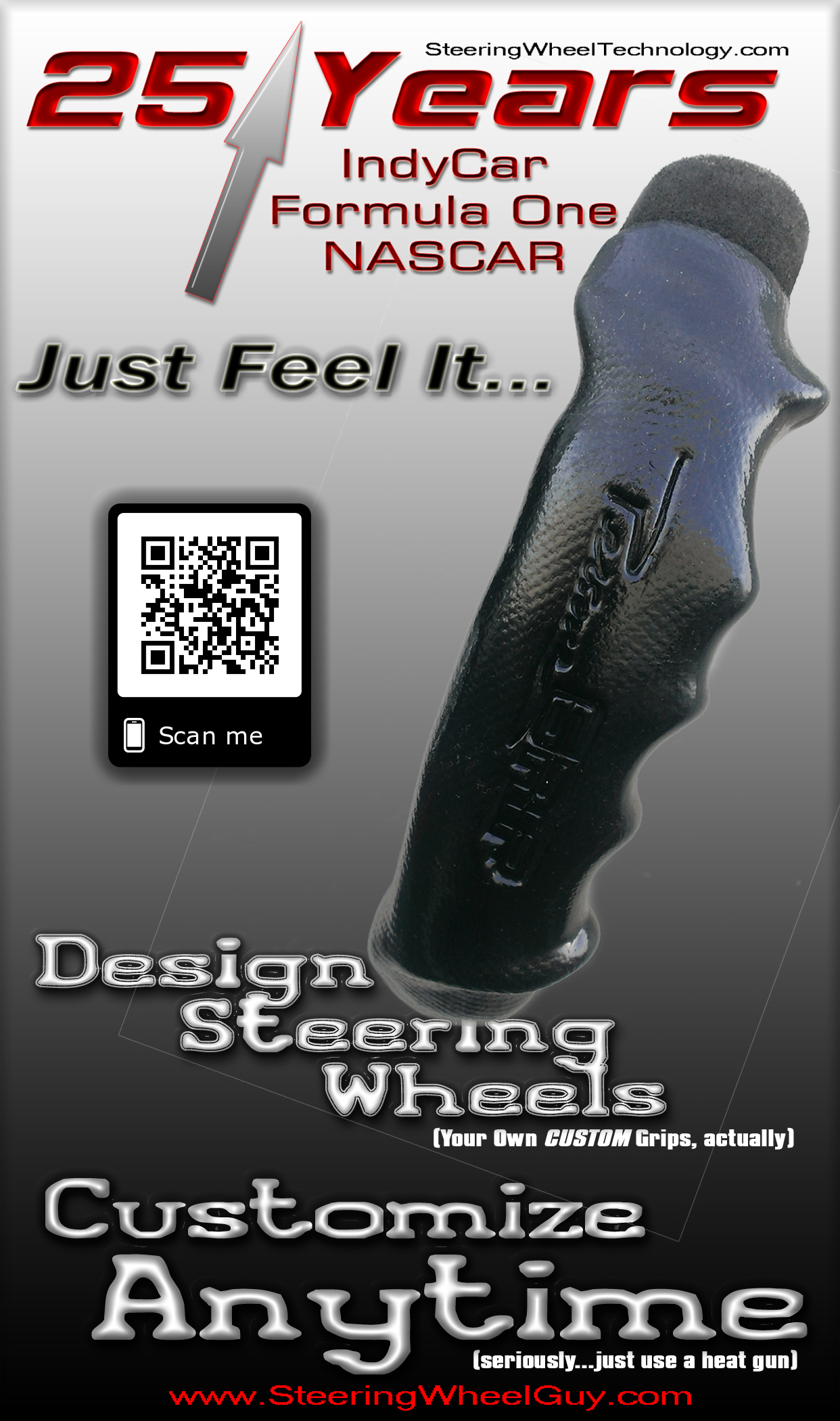
As inventor of the PersonaGrip custom-molded racecar steering wheels, I discuss designing the top wing on a racing steering wheel in this video.

Lessons learned from the world’s best drivers in IndyCar, Formula One, NASCAR, ALMS, et al. over the past 21 years are covered as I discuss how to design the custom grips so that all the modern safety features help drivers prevent blisters and broken fingers, reduce forearm fatigue, and improve steering feel.

I now have a method for drivers to design their entire custom steering wheels completely from scratch using only a sketch of it on a napkin.  In fact, the logo on this website is a wheel designed this way!

For more info:

http://www.SteeringWheelGuy.com